
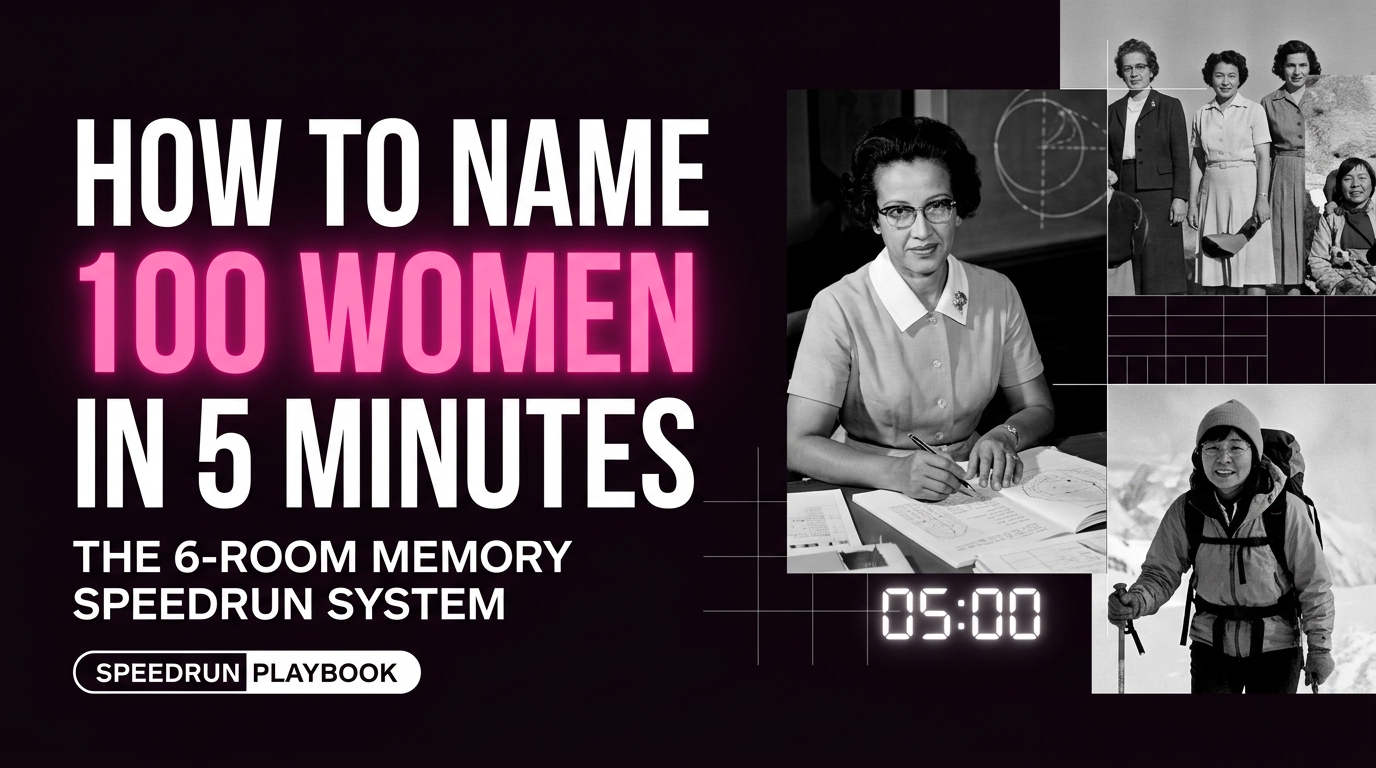
Learning how to name 100 women under a countdown clock is less about encyclopedic knowledge and more about indexing. Most first-time players on Name 100 Women start with high confidence. They easily knock out fifteen or twenty names in the first two minutes. Then, right around name thirty, they hit an invisible brick wall. The clock keeps ticking, panic sets in, and working memory locks up completely.
Breaking past that wall requires trading random guesswork for a spatial memory system. Serious trivia speedrunners use a customized 6-Room Memory Palace to retrieve all 100 figures in under five minutes.
Here is the exact routing blueprint, pacing schedule, and keyboard shortcut playbook to conquer the challenge.
1. The Speedrunner’s Dilemma: Why Random Recall Dies at Name 30
When you tackle an open-ended recall challenge without a plan, your brain defaults to immediate availability. You rattle off your mother’s name, three pop singers, a couple of current political figures, and two historical names from elementary school: Cleopatra and Marie Curie.
That unorganized pool rarely holds more than twenty-five names. Once it runs dry, your brain has nowhere to look.
A. The Cognitive Traffic Jam
When you search without boundaries, billions of historical records compete for working memory space. Your prefrontal cortex tries to scan everything simultaneously. The result is cognitive interference: names sit on the tip of your tongue, but competing memories crowd the exit. You lose two to three precious minutes staring at a blinking cursor.
B. Spatial Memory vs. Alphabetical Searching
Many players attempt an alphabetical recovery strategy: “Who is an A? Who is a B?” Alphabetical scanning is notoriously slow because semantic memory does not store historical achievements in alphabetical files.
Spatial memory, known as the Method of Loci or the Memory Palace, is vastly more efficient. By anchoring 100 women across six distinct architectural “rooms,” you give your working memory an explicit physical path to follow. Instead of wondering who to name next, you simply walk through the next door.
2. The 6-Room Memory Palace Blueprint
The official roster on Name 100 Women divides the historical catalog into six thematic categories. Your speedrun strategy maps directly to these six rooms:
Room 1: STEM & Inventions (The Laboratory)
Step into the laboratory first. Science figures are among the easiest to anchor because their names link directly to tangible breakthroughs:
- Marie Curie: Radium and polonium discovery, two Nobel Prizes in two different sciences.
- Ada Lovelace: World’s first published computer algorithm for Babbage’s Analytical Engine.
- Rosalind Franklin: Photo 51 and the double helix structure of DNA.
- Katherine Johnson: Orbital mechanics calculations that guided Apollo 11 to the moon.
- Grace Hopper: Pioneer of machine-independent programming languages and the first compiler.
- Chien-Shiung Wu: Experimental physicist who disproved the law of conservation of parity.
- Jane Goodall: Groundbreaking primatologist who transformed animal behavioral science.
Room 2: World Leaders & Reformers (The Council Chamber)
Next, step into the council chamber. Here you retrieve political powerhouses and civil rights champions who shaped governments and legal structures:
- Cleopatra: Last active ruler of Ptolemaic Egypt and legendary diplomat.
- Queen Elizabeth I: Presided over England’s Golden Age and defeated the Spanish Armada.
- Harriet Tubman: Underground Railroad conductor who guided dozens of enslaved people to freedom.
- Rosa Parks: Sparked the Montgomery Bus Boycott through quiet, resolute defiance.
- Indira Gandhi: First female prime minister of India and central figure in modern Asian geopolitics.
- Angela Merkel: Four-term German chancellor and de facto leader of the European Union.
Room 3: Literature & Philosophy (The Grand Library)
Move into the grand library. These figures are anchored to monumental manuscripts, poetic movements, and moral philosophy:
- Murasaki Shikibu: Classical Japanese noblewoman who authored The Tale of Genji, the world’s first novel.
- Mary Shelley: Invented modern science fiction at age eighteen with Frankenstein.
- Jane Austen: Master of social satire with Pride and Prejudice and Emma.
- Virginia Woolf: Modernist pioneer of stream of consciousness in Mrs Dalloway.
- Toni Morrison: Nobel laureate who chronicled the Black American experience in Beloved.
- Sylvia Plath: Iconic twentieth-century confessional poet and author of The Bell Jar.
Room 4: Visual Arts & Performance (The Studio Gallery)
Transition to the studio gallery. Focus on distinctive visual palettes and transformative musical voices:
- Frida Kahlo: Raw, surrealist self-portraits exploring Mexican identity and physical resilience.
- Artemisia Gentileschi: Baroque painter who defied seventeenth-century conventions with dramatic historical canvases.
- Billie Holiday: Transformed jazz vocal phrasing and challenged racial violence with Strange Fruit.
- Aretha Franklin: The Queen of Soul and first woman inducted into the Rock and Roll Hall of Fame.
- Yayoi Kusama: Visionary contemporary artist celebrated for infinity mirror installations and polka dots.
Room 5: Athletes & Explorers (The Stadium & Horizon)
Head into the arena and open skies. Anchor these names to record books, physical courage, and geographic milestones:
- Serena Williams: Won twenty-three Grand Slam singles titles in the modern Open Era.
- Amelia Earhart: First woman to fly solo across the Atlantic Ocean.
- Wilma Rudolph: Overcame childhood polio to win three Olympic sprint gold medals in 1960.
- Valentina Tereshkova: First woman to travel into space aboard Vostok 6 in 1963.
- Junko Tabei: Japanese mountaineer and the first woman to summit Mount Everest in 1975.
Room 6: Cultural Benchmarks & Pop Pioneers (The Pavilion)
Finish in the pavilion. These women reshaped global media, public health, and humanitarian care:
- Marilyn Monroe: Mid-century cinematic icon who challenged studio production monopolies.
- Florence Nightingale: Founded modern evidence-based nursing during the Crimean War.
- Helen Keller: Author and activist who broke through deafblindness to campaign for disability rights.
- Audrey Hepburn: Screen legend and devoted UNICEF goodwill ambassador.
The 6-Room Speedrun Routing Matrix
| Room Number | Thematic Domain | Target Quota | Anchor Sprint Names | Target Time Marker |
|---|---|---|---|---|
| Room 01 | STEM & Inventions | 17 Names | Curie, Lovelace, Franklin, Johnson, Hopper | Minute 0:00 – 1:00 |
| Room 02 | World Leaders & Reform | 17 Names | Cleopatra, Elizabeth I, Tubman, Parks, Gandhi | Minute 1:00 – 2:00 |
| Room 03 | Literature & Philosophy | 17 Names | Murasaki, Shelley, Austen, Woolf, Morrison | Minute 2:00 – 3:00 |
| Room 04 | Visual Arts & Music | 17 Names | Kahlo, Gentileschi, Holiday, Franklin, Kusama | Minute 3:00 – 3:45 |
| Room 05 | Athletes & Explorers | 16 Names | S. Williams, Earhart, Rudolph, Tereshkova, Tabei | Minute 3:45 – 4:30 |
| Room 06 | Cultural Benchmarks | 16 Names | Monroe, Nightingale, Keller, Hepburn, Goodall | Minute 4:30 – 5:00 |
3. Tactical Speedrun Hacks: How to Shave Minutes on the Input Engine
Speed on the countdown clock depends as much on typing efficiency as on memory retrieval. The interactive engine on Name 100 Women is built with smart matching algorithms that experienced players use to shave minutes off their runs:
A. Use Single-Surname and Alias Shortcuts
You do not need to waste time typing long formal names like “Countess Augusta Ada Lovelace” or “Marie Sklodowska Curie”. The engine recognizes short surnames and prominent aliases. Typing “Curie”, “Lovelace”, “Tubman”, or “Kahlo” triggers an immediate unlock. Over 100 entries, saving two seconds per name banks over three full minutes of clock time.
B. Sprint Within One Category Before Switching
Never bounce randomly between a scientist, a basketball player, and a seventeenth-century queen. When you open a mental chamber, stay there until you exhaust your immediate cluster. Keeping your neural focus in the laboratory lets related names fire automatically through associative priming.
C. What to Do When You Hit a Mental Wall
If you freeze for more than ten seconds, do not keep staring at the empty field. Jump immediately to the next room in your palace. Moving from STEM to Athletes often breaks mental fatigue instantly, and you can circle back to fill remaining slots during the final sprint.
4. Frequently Asked Questions (FAQ)
Q1: What is considered a good speedrun time on Name 100 Women?
A full 100/100 score completed under the fifteen-minute limit is a major accomplishment achieved by fewer than 5% of first-time players. Top-tier speedrunners using the 6-Room System regularly finish between four and seven minutes.
Q2: Do typos or misspellings invalidate your entry?
The verification engine includes fuzzy matching for common phonetics and transliterations, especially for non-Western names like Murasaki Shikibu or Chien-Shiung Wu. However, typing cleanly prevents wasted keystrokes.
Q3: How should I practice before starting an official timed run?
Turn on the Study Guide Mode located directly above the roster on Name 100 Women. This unmasks all 100 names and historical summaries so you can walk through your six rooms at your own pace before taking on the live timer.
5. Launch Your Official Speedrun
With the 6-Room System in your cognitive toolkit, you no longer have to worry about hitting the thirty-name wall. Review your room anchors, take a breath, and head to the Name 100 Women Challenge engine. Hit start on the countdown clock and see how fast you can claim all 100 spots.